Share Frederick "Fred" Alfred Hazouri's obituary with others.
Invite friends and family to read the obituary and add memories.
Stay updated
We'll notify you when service details or new memories are added.
You're now following this obituary
We'll email you when there are updates.
Select your format and elements to print

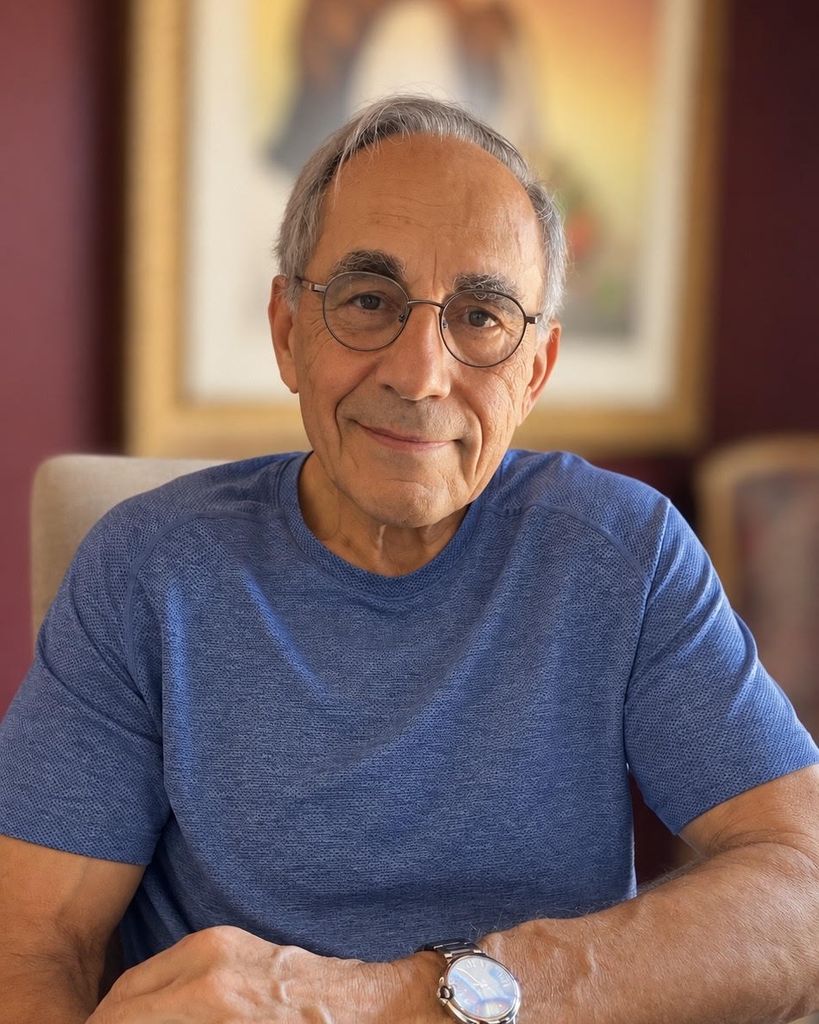

Frederick "Fred" Alfred Hazouri
Jun 10, 1943 — Sep 27, 2026
Fairness was the principle that ran through nearly everything Fred Hazouri did: the way he practiced law, the way he approached his work as a judge and mediator, the way he treated people, and the things he would—and would not—tolerate. He had little patience for prejudice or bigotry of any kind.
Some of the convictions that would stay with Fred for the rest of his life took root when he was still very young. For his high school graduation, he received two books that made a lasting impression on him: John Steinbeck’s The Grapes of Wrath and William Shirer’s The Rise and Fall of the Third Reich. They were very different books, but Fred saw something fundamental in both of them. One confronted poverty, class and the indignity that can result when people are treated as less worthy than others; the other confronted prejudice, injustice and their consequences. He never forgot those lessons. They helped shape the strong sense of justice and fairness that would guide him for the rest of his life. Years later, a sign in his office bore the familiar line often attributed to Edmund Burke: “The only thing necessary for the triumph of evil is for good men to do nothing.”
Fred was born and grew up in Jacksonville, Florida. An outstanding athlete, he was an all-star high school football player and graduated in 1960. He began his post-secondary education at the University of Florida, where he attended both undergraduate and law school. And all through his life, he remained a devoted Florida Gator.
Fred began practicing law in Palm Beach County in 1967. Over the years that followed, he rose to the highest levels of the trial bar and earned the respect of lawyers on both sides of the courtroom. He became known not simply for his skill as a trial lawyer, but for the judgment, preparation, integrity, and sense of fairness he brought to the profession.
At the height of his career as a lawyer, Fred chose to leave a successful private practice and, through merit selection, became a trial judge. He believed that judicial decisions had real consequences in people’s lives and viewed the position as an opportunity to contribute directly to a system in which fairness, balanced judgment, and equal justice could prevail for all who came before him. He disliked hearing judges refer to “my courtroom;” to Fred, the courtroom belonged not to the judge or the lawyers, but to the litigants who came there seeking justice – the people the courts were there to serve. Fred became widely known among the lawyers who appeared before him as a fair and even-handed judge—someone who listened, understood the law, treated people with respect, and tried to reach the right result without regard to personalities or politics.
He consistently received the highest marks in surveys of lawyers for his judicial performance, even-handedness and demeanor. After several years as a trial judge, he applied for and was appointed to Florida’s Fourth District Court of Appeal, where he served until reaching the mandatory retirement age of 70. In the last stage of his professional career, he became a much sought-after mediator who could counsel parties on the wisdom of resolving their disputes amicably from the accumulated perspective of a trial attorney, trial judge and appellate jurist.
Away from the law, Fred and his spouse, Barbara Pariente (a former justice of the Florida Supreme Court) spent summer months at their home on Cape Cod, where Fred delighted in tending his flower garden. They loved traveling together, and Fred’s favorite place in the world was Paris (specifically the Left Bank), to which they returned year after year.
Fred remained an avid cyclist and took great pride in staying fit. Long after many people his age had slowed down, he continued riding his bicycle regularly, lifting weights, exercising, and living an extraordinarily active life. He was also a lifelong and voracious reader, with tastes that ranged from John Irving to Maggie O’Farrell to Elizabeth Strout.
Together for more than 45 years, Barbara and Fred combined their families into one that eventually grew to include three children and their spouses David Hazouri (Lynne Graubert), Leslie DiTocco (Paul), and Joshua Pariente Koehler (Jill Mahler), 11 grandchildren, and one great-grandchild. Fred is also survived by his two younger sisters, Cathryn Hazouri and Selma Hazouri, and an adoring extended family.
To his grandchildren, he was simply “Papa” or “Baba,” and they loved spending time with him. As each reached a certain age, Fred created a tradition: he took it upon himself to bring that grandchild, one at a time, to Cape Cod for a visit with just the two of them (making it something uniquely their own). While they were there, he shared some of the things he loved, including summer evenings at Cape Cod Baseball League games, candlepin bowling, and trips into Boston to see the Red Sox play at Fenway Park.
Within the family, Fred was a remarkably steady presence. He was dependable and could be counted on. He liked to invoke a line from Dr. Seuss’s Horton Hatches the Egg: “I meant what I said and I said what I meant. An elephant’s faithful, one hundred percent.” It fit him. He was also easy to talk to and a good listener, someone who could hear what you were going through without immediately judging it or trying to fix it. There was something reassuring about knowing that Fred would remain Fred: calm, even-keeled, and there when he was needed.
Perhaps the best way to capture another side of Fred is through one of his favorite New Yorker cartoons: a man reaches a mountaintop in search of wisdom from a guru, who tells him, “You do the Hokey Pokey and you turn yourself around. That’s what it’s all about.” That, too, was Fred: deeply serious about the things that mattered, but never without a sense of the absurd. He will be forever missed by all who knew and loved him.
Fred’s family is immensely grateful to Dr. Jorge Dietrich, a neuro-oncologist at Massachusetts General Hospital (MGH) in Boston, and to his entire team for the care and treatment Fred received following his diagnosis of glioblastoma (an aggressive form of brain cancer) in June 2025. In lieu of flowers, the family asks that those wishing to honor Fred consider a contribution either to brain cancer research at MGH, in gratitude for the extraordinary care Fred received, or to the Legal Aid Society of Palm Beach County, whose work reflects Fred’s belief that justice should not depend upon who you are or what you can afford.
Donations in support of brain cancer research may be made to: MGH Development Office, Attn: Isabella Camelo, Brain Cancer Research Fund of Dr. Jorg Dietrich, 125 Nashua Street, Suite 540, Boston, MA 02114-1101. Donations in support of the Legal Aid Society of Palm Beach County may be made securely online or by check or money order payable to Legal Aid Society of Palm Beach County and mailed to: Attention: Philanthropy Department, 423 Fern Street, Suite 200, West Palm Beach, FL 33401.
Guestbook
Visits: 4
This site is protected by reCAPTCHA and the
Google Privacy Policy and Terms of Service apply.
Service map data © OpenStreetMap contributors